
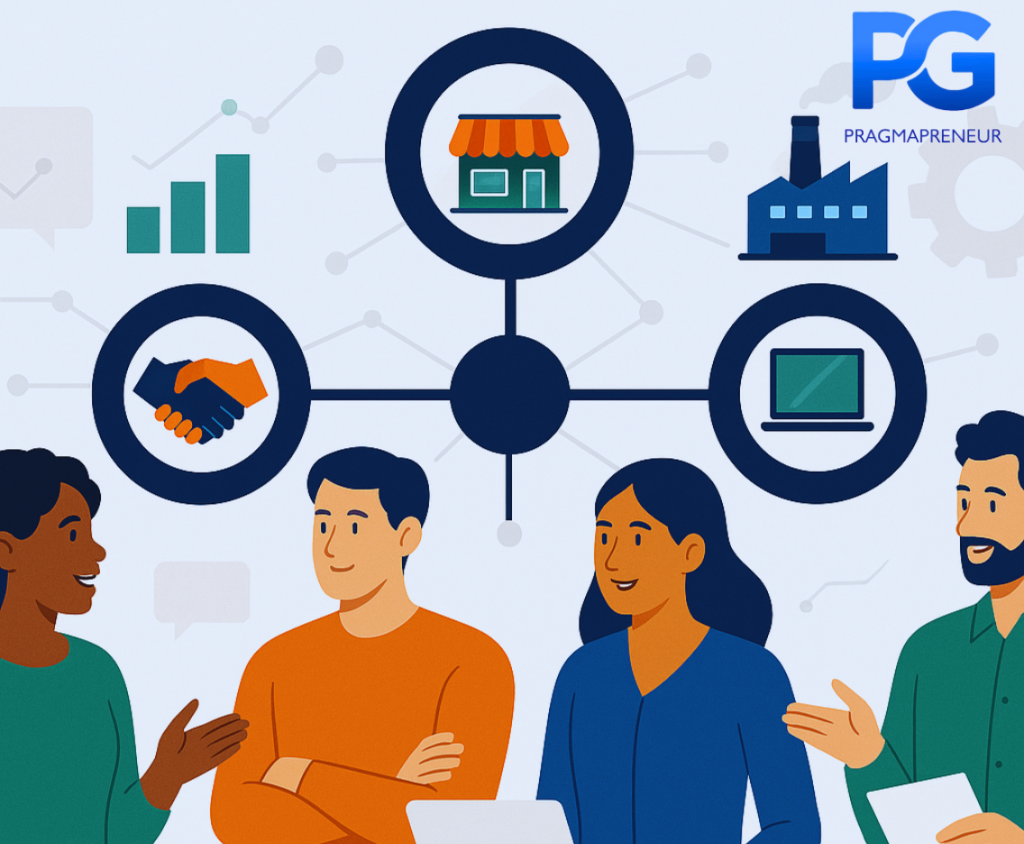
Business is more than suits and meetings. Each time you grab your morning coffee from that nearby café, subscribe to your music streaming app, or order a product a you love online, you are part of the system that we refer to as business, the engine that drives the economy and a creative force in our lives.
And yet, despite hearing the word all the time, many are left with the question of how to clearly define what it actually is. Whether you want to start your own business, trying to make sense of economics, or simply interested in the world around you, an understanding of business basics is necessary.
Key Insights
- The core purpose of a business is to serve customers by fulfilling a need or desire. Profits follow when value is created.
- Businesses come in many legal forms: sole proprietorships, partnerships, corporations, LLCs, cooperatives, and more
- Operations, marketing, finance, HR, and strategy are the engines that keep a business running.
- Profit motive, risk-taking, organization, and continuity are some of the essential traits that distinguish a business from a hobby or charity.
Definition of Business (Business Meaning)
A business is any enterprise or company which transacts goods or services for money.
It may be a sole trader fruit stall, a family tailoring business, a brand new mobile-money business, or a huge multinational. What binds them all is value exchange: businesses employ resources such as time, raw materials, and capital to produce something for which other people will pay.
For instance, a bakery supplies bread for hunger, and an accountant provides financial advice. Both are businesses since they continuously offer goods/services meeting wants in order to generate more than they use.
Most businesses aim to make profits, but there are non-profit businesses that seek to promote a social cause.
Why Business Exist
Key reasons businesses exist include:
1. Customer Needs & Satisfaction
Survival of the business depends upon keeping the customer satisfied. It offers the good or service that people desire or require like food, clothes, education, etc.
Satisfied customers return and generate revenue.
2. Profit and Growth
The entrepreneur receives payment through profit which serves as compensation for taking risks and enables business expansion. A business needs profit to survive and expand its operations.
A technology start-up can expand its workforce through profit while an independent store can purchase additional stock with their earnings.
3. Jobs & Economic Development
Business operations generate employment opportunities which directly impact how people live.
The World Bank shows that small and medium enterprises (SMEs) represent 90% of all businesses worldwide and generate more than half of global employment which demonstrates their essential role in job creation and economic growth.
4. Innovation & Community
Businesses must innovate through new product development and process enhancement and technological advancements to maintain market competitiveness.
The development of new products and farming techniques by agricultural businesses and smartphone technology improvements for communication represent two examples of societal benefits from innovation.
Types of Business

There are different types of businesses. They can be classified by ownership, size, sector, and model.
By Legal Ownership/Form
1. Sole Proprietorship
Owned and run by one person. It is the least complicated organization. Take for instance, a neighborhood barber or a roadside repairperson. Both are usually sole proprietors. No distinction is made between the owner and the business, so the owner retains all income but all risks as well.
2. Partnership
Two or more people run the business together. Profits and losses are shared under a partnership agreement. Small law firms or small family stores can be partnerships. An example is a Limited Liability Partnership (LLP), where some partners can limit their personal liability.
3. Corporation (Limited Company)
A larger business registered with the government as its own legal “person.” Shareholders own the company through stock, and their own liability is limited. Corporations are able to raise cash by selling shares but are more regulated.
A Private Limited Company is like a small corporation, while a Public Limited Company can sell shares on a stock exchange.
4. Cooperative
Owned and run for the benefit of its members, who might be workers or customers. Any profit is usually retained or distributed to members. Examples are some consumer cooperatives or farm cooperatives. It’s concerned with meeting the needs of members rather than profit maximization.
5. Limited Liability Company (LLC)
A hybrid entity combining features of partnerships and corporations. Owners (“members”) have limited liability like a corporation, but can choose flexible tax treatment (often pass-through like a partnership).
An LLC may consist of one or more members. It’s best suited for small and medium-sized businesses since it provides protection for liability with less formality.
By Size
1. Micro & Small Enterprises
Very few employees (often under 10). Example: A street food vendor or a small local café. These tend to be operated informally and are often operated by the owner directly.
2. Medium-sized Enterprises
Dozens of employees. SMEs are typically described by most nations on the globe as companies with medium-sized assets and between 10 and 199 workers. Common examples are expanding technology-based start-ups or medium-scale producers.
3. Large Corporations
Hundreds or thousands of employees, often with multiple branches or international presence. Example: International conglomerates in manufacturing, retailing, or the food business. Large organizations have special divisions and official hierarchies.
By Industry Sector
1. Primary (Extraction/Agriculture)
This sector involves the extraction of raw materials or natural resources. Example: Agricultural estates, fishing and forestry businesses, or mining operations.
2. Secondary (Manufacturing/Construction)
Businesses in this industry transforms raw inputs into final products. Example: Factories producing furniture or soft drink bottling factories.
3. Tertiary (Services)
Businesses that provide services rather than physical goods. Example: Banks, schools, hospitals, retail outlets, or telecom service providers. This industry keeps the economy running through value-added services.
Advanced economies often add a Quaternary sector for knowledge-based work like software or research.
By Business Model (How they operate and sell)
1. B2C (Business-to-Consumer)
Sells directly to individual customers. Example: A fashion boutique that delivers clothes to consumers.
2. B2B (Business-to-Business)
Sells to other businesses. Example: A steel mill selling beams to construction companies.
3. Franchise
A model where one company (franchisor) allows others (franchisees) to operate under its brand and system. Example: A chain restaurant or retail outlet like McDonald’s.
4. E-commerce/Digital
Exists primarily online. Example: Jumia, an African online retail platform.
Other Models such as subscription-type services (e.g. streaming websites) or freemium apps (service for free, premium for money) are prevalent as well.
Features of a Business
While businesses differ in focus, they share certain core features that define what business is:
1. Exchange of Goods/Services
Business involves providing something of value which could be a product or service to customers in exchange for money.
Whether selling gadgets, software, haircuts or meals, the focus is on meeting a demand. Without this exchange, there is no business.
2. Continuous and Repetitive Transactions
Selling something once (like your car) isn’t typically called a business. Businesses usually plan for the long term.
They don’t start and stop randomly; instead, they aim for continuity and growth over time. In other words, you plan to keep selling, not just do a one-time sale.
3. Profit Motive
While a business might serve a social purpose (like a nonprofit), most are driven by profit – earning more than they spend.
Profit is what drives the business, enables it to expand, pay workers, and invest in improved products. In short, it’s the gas that powers the business.
4. Use of Resources (Inputs)
Every business requires resources – land (or location), labor (people’s work), capital (money, equipment), and entrepreneurship (the owner’s skill).
These inputs have to be used wisely so that the products or services on behalf of which the clients are being paid can be offered. These are also referred to as the four production factors in economics, and scarcity implies companies attempt to use them without wastage.
5. Element of Risk
Any business is vulnerable to risks – economic instability, shifts in market taste, new regulation, or competition. Entrepreneurs must invest resources (e.g., time and money) without any certainty of success.
For example, an IT company may spend thousands of dollars in coming up with a new app without being sure if the clients will pay for it.
6. Regulation and Ethical Role
Modern businesses also operate under laws and social expectations. They must register with government officials, pay taxes, and avoid engaging in unfair trade practices.
For example, a start-up computer firm must comply with data privacy laws, and a factory must address pollution issues responsibly.
7. Innovation and Competition
Competition is a natural result of business activity and feature of a free market. When one bakery makes a better bread, other bakeries within proximity improve to keep customers.
This leads to ceaseless innovation (new ideas, products) and generally more consumer-friendly prices. Healthy competition does not permit monopolies and keeps the economy energetic.
Main Functions of Business

What does a business actually do day-to-day? We can think of this in terms of business functions – the core activities every company needs to cover. No matter the industry, a successful business usually carries out the following key functions:
1. Product or Service Development (Production/Operations)
This is your core function – making the product or service you sell. For a factory, that means manufacturing; for a software firm, programming; for a restaurant, cooking.
Without a product/service, you have nothing to sell.
2. Marketing and Sales
After you’ve made it, you have to sell it. The marketing function is discovering what the customer is looking for, selling the item (advertising, social media, etc.), and getting them to know it and want it.
Then sales (usually divided in smaller companies) is really closing the sale.
3. Finance and Accounting
A business must manage its finances. The finance function oversees earnings and expenditures, budget the expenses, raises funds (borrowings or investors), and settles bills. It keeps healthy cash flow.
Proper bookkeeping and budgeting are necessary – they enable the owners to understand if the company is making profit or operating in the red.
4. Human Resources (HR)
All businesses have individuals, whether it’s a staff of thousands or a handful of assistants. HR hires and trains employees and keeps them motivated.
It decides who to hire, how to compensate and benefit, and handles workplace conflicts. Even a small business has to contend with at least itself and maybe one employee, so this role scales with business size.
5. Customer Service
Sales-related, this is the activity of serving the customer after purchase. With most companies, happy customers mean repeat business and word-of-mouth.
This can include answering product questions, handling returns, or providing maintenance.
6. Research & Development (R&D) / Innovation
Not all businesses have an R&D department, but it’s necessary to innovate in the long run. It is about improving your product or processes, like a bakery comes up with a new bread recipe, an app adds new features or the owner of a small business experimenting with new things.
Innovation keeps the business competitive.
7. Strategy and Management
This is the leadership function. The owners or managers must think ahead: set objectives, choose new markets, and make adjustments.
Strategy is to pose the question “Where do we want to go, and how will we get there?”
8. Logistics and Supply Chain
Sustaining inputs and outputs in motion. For a retailer, it’s ordering inventory and getting products on the shelves; for an exporter, it’s shipping goods abroad. This function manages suppliers and distributors.
It may be included in operations at times. Efficient logistics can reduce costs and deliver customers what they need by the deadline.
9. IT and Systems
Information technology (computer systems, websites, databases) underpins almost every business function in modern business. Operating an IT system or a website might be a specialist function (more likely in technology companies), or outsourced in a small company.
10. Miscellaneous (Legal, Maintenance, Admin)
There are other functions that are needed which are legal (registration of the business, contracts), buildings maintenance, and general admin tasks.
These support all the above functions.
How Businesses Make Money: Revenue Models Explained
A revenue model is how a business generates money. It’s how it intends to generate money from its products or services. Having a clear revenue model directs a business to focus on its customers and financial goals.
Some of the most commonly used revenue models are:
1. Sales Model (Product Sales)
The business makes money through the direct sale of goods or services to consumers. For example, a bakery sells each loaf of bread at a constant price.
This is a one-to-one model, where the revenue comes from each sale.
2. Subscription Model
People pay a monthly, yearly, etc., recurring subscription to keep on using something such as a product or service. Netflix streaming, Microsoft 365 software-as-a-service, or subscription boxes would be examples.
The revenue is consistent and predictable as long as the subscribers stick around.
3. Advertising Model
Free or low-cost content/services are provided by the company and they earn profit through the publication of ads. Media companies, websites, or mobile apps usually implement this.
For instance, a blog or social media website may be free to access, yet has advertisements and earns revenue from advertisers. Google and Facebook are well known to implement this model.
4. Commission/Brokerage Model
The company receives a cut or commission from deals it brokers between others. For example, house sales earn real estate agents a commission, while online auction sites (e.g., eBay) take a percentage of every sale they make.
This is like a markup model, though, as an intermediary.
5. Licensing Model
The firm sells rights to utilize their intellectual property but not the ownership. Software companies do this – they don’t distribute copies but license using the software. Media franchises license characters or content.
Licensing can earn revenue without the firm actually selling additional units.
5. Freemium Model
A hybrid model in which the standard product/service is free, while premium options are paid for. The majority of games and applications are so: test the free one and pay for the extras or to not have ads.
6. Rental/Leasing Model
Instead of selling the product, the business generates income by leasing it out. A good example would be car rental companies or equipment leases.
The customer pays for the use over time.
Common Challenges Businesses Face (and How to Overcome them)

All businesses, big and small, face challenges. Understanding what common challenges there are and how to overcome them is the secret to success. Below are some common challenges:
1. Economic Uncertainty
Market crashes, recessions, or global events (like pandemics) can upset demand and supply. Firms must now re-strategize, cut expenditures, or seek alternative sources of revenues.
Firms can diversify their product offerings, cut costs, or focus on maintaining cash cushions to weather the tempest. Keeping money in one’s pocket and being agile allows firms to remain alive during times of economic uncertainty.
2. Strong Competition
Markets are over-saturated in most markets. Differentiation relies on continuous innovation and strong value proposition.
Firms need to differentiate their offerings – perhaps better quality, lower prices, or differentiated attributes. Knowledge of competitors’ strengths and weaknesses and market research help. Great service or branding also attract committed customers
3. Cash Flow Control
Most small or new firms lack cash flow control. Successful business can even go out of business if they are short of money because customers pay late or bills are not paid on time. It is catastrophic – running short of money is a top reason for business failure.
Avoiding it by using good forecasting and budgeting is done by businesses. By having clear payment terms, holding cash balances, and having loans or credit lines, they can rest assured that they have funds to continue.
4. Talent Finding and Maintenance
Getting and keeping quality, dependable workers is normally difficult, particularly in competition with large corporations.
Companies are forced to provide competitive compensation, benefits, and health culture. Permitting career growth and training attracts quality Talent Hiring the right workers when they are hired, worker motivation (through proper management, selection, and development programs) lessens turnover.
5. Adjusting to Technology Changes
As seen, technology evolves extremely fast. Businesses that fail to adopt advancing tech are in danger of falling behind. For instance, a brick-and-mortar store not focusing on e-commerce loses to its online counterparts.
Successful businesses embrace digital disruption: they adopt e-commerce, leverage data analysis in understanding trends, and adopt automation in routine tasks. Fostering question-oriented culture where employees seek innovative answers facilitates adjustment.
6. Compliance with Laws and Regulations
It is challenging to comply with laws and regulations (safety codes, environmental regulation, taxation). Mistakes lead to lawsuits or fines.
To avoid this, compliance mechanisms are in place, one keeps track of changing legislations, and even hires experts (like lawyers or accountants) to advice them sometimes.
7. Meeting Customer Needs
Customers are picky these days and they have plenty to choose from. Value and good service are essential.
Being responsive to customer grievances, constantly improving products, and practicing good customer service are vital. Building relations and keeping a good reputation ensures repeat business.
How to Know If Your Idea Is a Business (Checklist)
Not every one-off sale or project is a “business.” Ask yourself: does your idea pass the business tests? Here is a quick checklist:
- Economic Activity: Do you plan to repeatedly sell goods or services for money? If it’s a one-off sale or simply a friendly gift, it’s not a business. Business is repeated economic activity.
- Profit Motive: Would you like to earn more money than you are spending? Businesses want profit although they do have other aims as well.
- Customer Focus: Is there really demand in the market? You’re creating or fulfilling a need or want. Remember business is customer-making not merely doing what you love.
- Continuity: Will the activity be done on a regular basis over time? E.g. selling bread daily vs selling your own bread once.
- Risk Involved: Are you investing time, money without a sure return? Business ventures always involve risk.
- Legal & Formal: Are you making it formal (e.g. registration of business, obtaining licenses, opening accounts)?
If your venture possesses these characteristics – exchange of value, objective of profit, ongoing, and risk – then it’s likely a business venture.
Key Business Terms Everyone Should Know
- Business: An institution that provides products or services to customers for money.
- Profit: Funds a firm has left over after all expenses have been subtracted. (Calculations: Profit = Revenue – Expenses).
- Revenue: Overall income received from selling products or services before expenses are subtracted.
- Cost/Expenses: Funds spent running the business (e.g., materials, wages, rent).
- Business Model: A plan for how an enterprise makes, delivers, and captures value (i.e., makes its money). For example, the subscription model or freemium model.
- Market: The group of prospective customers for an item or service. Firms research the market so that their product fits.
- Stakeholder: Anyone with a stake or interest in a firm (e.g., owners, workers, consumers, suppliers, community). Stakeholders are affected by or can affect the performance of a business.
- Shareholder: Person or institution holding shares (stock) of a corporation and thus part of the firm. Shareholders expect a return on investment.
- Liability: Legal responsibility for liabilities and debts. In companies, “limited liability” means that the owners are shielded from financial loss personally beyond their investment.
- Equity: Value of business ownership (e.g., stock). When a company is sold, equity is what the owners get after paying off debts.
- Cash Flow: The money flowing into and out of a business. Positive cash flow means there is more coming in than going out, which is the need for day-to-day business.
- Brand: A name, symbol, design, or image that differentiates a business or product and marks it as unique from others.
- Supply Chain: All of the suppliers and operations that move goods from raw materials to finished product delivered to customers.
Read Also
The Role of Technology in Business
The Complete Guide to Entrepreneurship: From Idea to Success
How to Start a Business with No Money in 2025
How to Use ChatGPT Effectively for Business (+Free Prompt Examples)
Conclusion
Business is something more than buying and selling goods and services; it is the basis of economies and an exhibition of human ingenuity, want, and desire. Whether a small business startup or a multinational enterprise, all business has a purpose: to build value, resolve issues, and advance progress.
Learning about the definition, types, characteristics, and functions of business not only gives knowledge, but also provides a lens through which to observe how opportunities are developed, how economies prosper, and how value moves through society.
“Your business deserves a digital presence that commands attention. Let’s create a custom website that works for your goals. Reach out to us on WhatsApp today!”